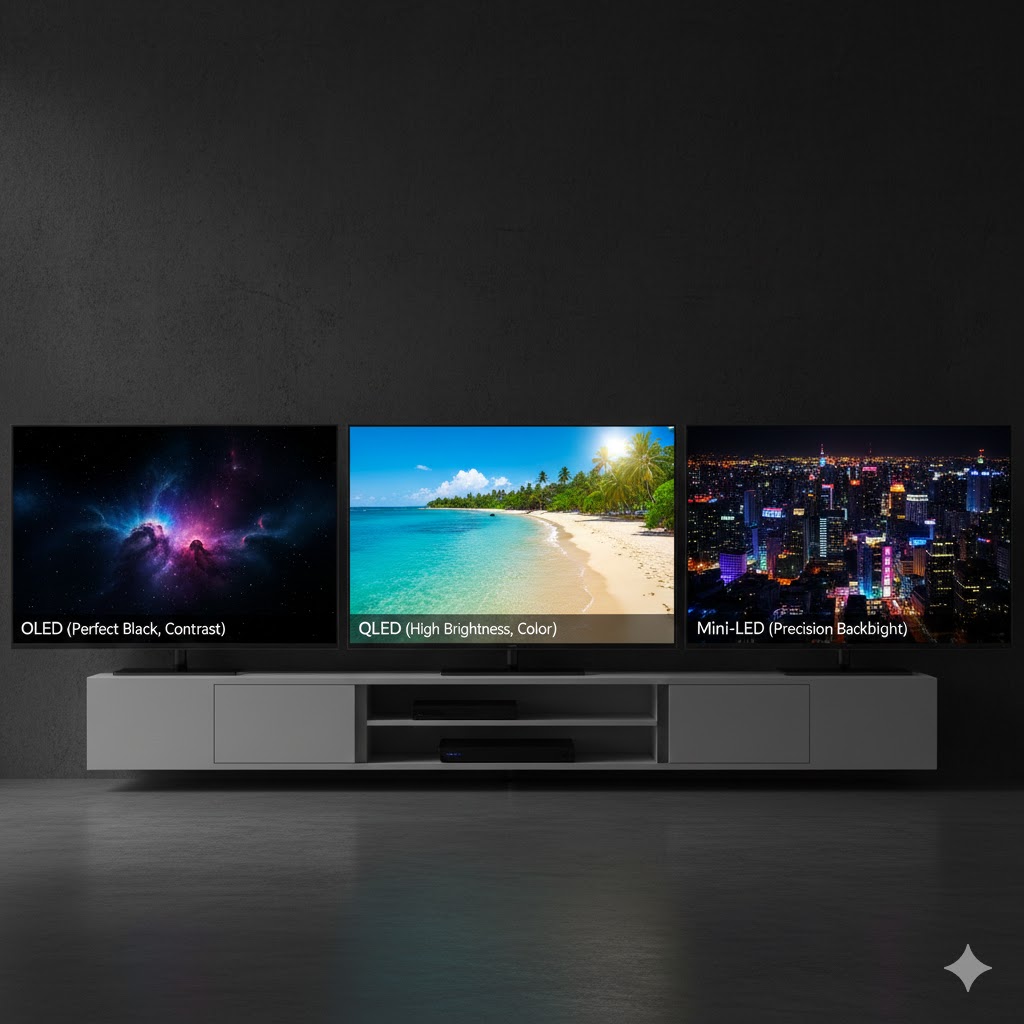
Choosing between OLED, QLED, and Mini-LED is the most common dilemma for anyone buying a new TV. While they all look great in the showroom, they use very different technologies that perform better in certain environments.
Here is a simple breakdown to help you decide which one is right for your home.
1. OLED (Organic Light Emitting Diode)
The King of Contrast.
OLED is unique because it doesn’t use a backlight. Instead, every single pixel is its own light source (self-emissive). When a pixel needs to show black, it simply turns off completely.
-
Pros: “Perfect” blacks, infinite contrast, and ultra-wide viewing angles (the picture looks great even from the side).
-
Cons: Not as bright as LED-based TVs. There is a small risk of “burn-in” if you leave static images (like news tickers) on for thousands of hours.
-
Best For: Movie buffs, dark room viewing, and high-end gaming.
2. QLED (Quantum Dot LED)
The Champion of Brightness.
QLED is essentially a standard LED TV with a special “Quantum Dot” film added. This film enables the TV to produce much more vibrant and accurate colors than a traditional LED TV.
-
Pros: Extremely bright (great for sunny living rooms) and zero risk of burn-in. Usually more affordable than OLED in larger sizes.
-
Cons: Because it uses a backlight, it can’t achieve “true” black. You might see some “blooming” (a halo effect) around bright objects on dark backgrounds.
-
Best For: Bright living rooms, daytime TV watching, and budget-conscious buyers wanting big screens.
3. Mini-LED
The Middle Ground.
Mini-LED is an evolution of QLED. Instead of using a few dozen large LEDs for the backlight, it uses thousands of tiny LEDs. This allows the TV to control brightness in very specific areas (Local Dimming).
-
Pros: Much better contrast than standard QLED and significantly higher brightness than OLED. It gets very close to OLED’s black levels without the burn-in risk.
-
Cons: Can still show some blooming in very difficult scenes (like stars in a night sky). It is often as expensive as OLED.
-
Best For: Users who want OLED-like performance but need high brightness for a well-lit room.
Quick Comparison Table
| Feature | OLED | QLED | Mini-LED |
| Black Levels | Perfect | Good | Great |
| Brightness | Average | Excellent | Best |
| Viewing Angle | Best | Narrow | Average |
| Burn-in Risk | Low (but possible) | None | None |
| Ideal Room | Dark / Cinema | Bright / Sunny | Any |
Summary: Which should you choose?
-
If you want the absolute best picture quality for movies and you usually watch TV at night: Go OLED.
-
If your TV is in a room with lots of windows and sunlight: Go QLED or Mini-LED.
-
If you want high-end performance but are worried about longevity and burn-in: Go Mini-LED.